
Category: IM
-
/
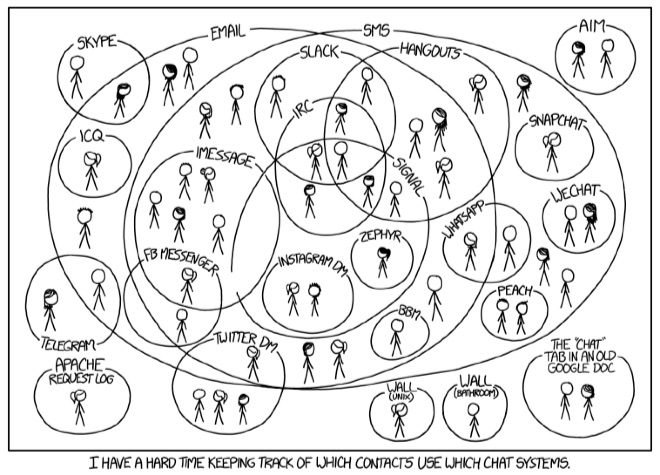
XKCD Comic Perfectly Captures Sad, Fragmented State of Messaging / Chat Systems
Continue Reading: XKCD Comic Perfectly Captures Sad, Fragmented State of Messaging / Chat SystemsIn one picture, this comic from xkcd nails the very sad state of fragmentation with our messaging systems today. The text says:
I have a hard time keeping track of which contacts use which chat systems.
And that is our major pain point today.
Think about it… do you know how to reach most of the people you need to communicate with?
Some readers may have just decided that they are going to ONLY use one service. They communicate on only, say, Facebook. Or WhatsApp. (Or in one case I know, someone has rejected all new messaging apps and will only communicate with email.)
And so if you want to communicate with them you have to use their one service.
But of course, if you want to communicate with other people, you have to use their service… which leads to this comic and the mental energy we all must expend to remember (names are made up):
- George likes to get Twitter DMs
- Sue and Jose only use Facebook Messenger
- Carlos only uses WhatsApp
- Heidi, Frederick and Laura only use Wire
- Your parents all use iMessage… except when they decide to use Facebook Messenger
- Your teenage kids…
- George likes to get Twitter DMs
-
/
My First RFC – 7649 On “The Jabber Scribe Role at IETF Meetings”
Continue Reading: My First RFC – 7649 On “The Jabber Scribe Role at IETF Meetings”Last month the first Request For Comments (RFC) was published where I was one of the co-authors. Ironically, this RFC 7649 had nothing to do with SIP, VoIP, telecom, IPv6, DNSSEC, security… or any of the other open Internet standards I’ve been working on in recent years!
In fact, it’s not a “standard” at all but rather an “informational” document.
This document collects together a series of best practices for how someone can fill the role of the “jabber scribe” at IETF meetings, such as the IETF 94 meeting about to happen in Yokohama, Japan, starting this weekend. (Which I will not be attending due to scheduling challenges.) You can read RFC 7659 at:
As the abstract states:
During IETF meetings, individual volunteers often help sessions run more smoothly by relaying information back and forth between the physical meeting room and an associated textual chatroom. Such volunteers are commonly called “Jabber scribes”. This document summarizes experience with the Jabber scribe role and provides some suggestions for fulfilling the role at IETF meetings.
The document came about because over the years that I’ve been involved with the Internet Engineering Task Force (IETF) I’ve come to both value the critical role…
-
/
Google Finally Kills Off GoogleTalk and XMPP (Jabber) Integration
Continue Reading: Google Finally Kills Off GoogleTalk and XMPP (Jabber) IntegrationGoogleTalk is dead, Jim!
By way of a comment to a post I wrote back in May 2013 about Google seeming to kill off XMPP/Jabber support in Google+ Hangouts (spoiler: They did!), I learned from a friend that the GoogleTalk API was officially deprecated as of February 23, 2015. I confirmed this by finding a Google+ post from Google’s Mayur Kamat.
Now, this is not a surprise. Google has been clear that Hangouts was the replacement and also that Hangouts does not support XMPP:
Still, I’m sad to see the XMPP integration die off. It is just a continuation of the descent of messaging services into walled gardens … a topic I’ve been writing about for many years. UPDATE: Please see the post “No, it’s not the end of XMPP for Google Talk” on the XMPP Standards Foundation site. The XSF notes that XMPP is still used inside of Google and that XMPP federation can still occur with a third-part XMPP client. However, because Google does not support the secure use of XMPP via TLS, many public XMPP servers will not connect to its server. I join the XSF in wishing that Google would embrace secure messaging and better…
-
/
Skype 4.2.1 for iPad/iPhone Brings Microsoft Integration, Chat Interop, Better IM Features
Continue Reading: Skype 4.2.1 for iPad/iPhone Brings Microsoft Integration, Chat Interop, Better IM FeaturesSkype today brought its increased integration with Microsoft services to the iPhone and iPad with the new release 4.2.1 available in the iOS AppStore. As you can already do in the Windows, Mac and Android versions of Skype, the big feature is that you can now sign in with your “Microsoft account” and merge our Skype contacts with those from Windows Live Messenger (WLM) and Outlook.com. You will now be able to chat back and forth with your WLM contacts directly from within Skype.
This is very cool from the point-of-view that Skype has always been a “walled garden” of instant messaging (IM) that did not interoperate with any other service. Many of us long ago wound up having to use two IM clients on our system: 1) Skype; and 2) a multi-service client (like Adium or Pidgin) for all the other IM networks. This doesn’t quite solve that problem because it is now really just expanding the Skype client to work with two IM networks, but it is at least a step toward greater interop.
In a post on Skype’s “Garage” blog, Beom Soo Park indicates these new features:
- Sign in with your Microsoft Account to merge your Windows Live…
-
/
Watch the Royal Wedding? Or talk about XMPP? Join VUC on April 29th for an XMPP-fest
Continue Reading: Watch the Royal Wedding? Or talk about XMPP? Join VUC on April 29th for an XMPP-festSo which would you rather do? Watch the Royal Wedding? Or talk about all things XMPP with a bunch of VoIP and telephony geeks?If you’d prefer the latter, then join the VUC conf call at 12 noon US Eastern on Friday, April 29, for a lengthy dive into all things XMPP. (XMPP being the “Extensible Messaging and Presence Protocol” originally known as the Jabber protocol.)
As noted on the show page the session will feature Emil Ivov of Jitsi.org (formerly SIP Communicator) and Thiago Rocha Camargo (of Nimbuzz) and is going to cover a whole range of topics:
- What is XMPP/Jabber
- How does one do telephony with XMPP
- How does XMPP/Jingle compare to SIP and (why) is it better.
- Who supports it
- Facebook and their XMPP gateway
- Google Talk
- Nimbuzz – one of the biggest VoIP providers using XMPP as their primary protocol
- NAT traversal
- How does one do it with XMPP
- Again, how is this part different from what we have with SIP
- Media relaying with TURN and Jingle Nodes
I am a big fan of XMPP on the IM/messaging side so I’m very much looking forward to this conversation.
You can join the live call via SIP,…
-
/
How To Set A Skype Chat So That New Arrivals See (Some) Chat History
Continue Reading: How To Set A Skype Chat So That New Arrivals See (Some) Chat HistoryWould you like to make it so that when you add someone to a Skype chat they automagically see some of the recent history of the chat? So that people joining a team or a project can rapidly come up to speed on what has been discussed?This turns out to be ridiculously easy to do in a Skype group chat. An administrator for the chat simply has to type in the chat window:
/set options +HISTORY_DISCLOSED
After this, anyone joining the chat will see recent history. Per Skype’s FAQ on chat commands:
Joiners can see the conversation that took place before they joined. The limit that they can see is either 400 messages or two weeks of time, depending on which is reached first.
I’ve enabled this setting on a number of chats for which I am an admin, and it’s definitely helped newcomers come up to speed on what is being discussed in the chat. (Of course, some of those chats are very busy and so 400 messages may only take you back a very short period of time.)
Note, again, that you must be an administrator of a Skype chat for this command to actually execute. You…
-
/
How To Use IRC-style Commands In A Skype Chat
Continue Reading: How To Use IRC-style Commands In A Skype ChatMany folks who are new to using Skype for group chat may not be aware that Skype brings along some of the commands that are popular in IRC chat systems – and the general “/” style of commands used in IRC. To see the list of commands, simply go into any Skype chat (it could even be a chat with only one other person) and type the following command:/help
This will work on old and new versions of Skype and will give you a list of what commands are available:
Available commands:
/add [skypename]
/help
/topic [new topic]
/me
/history
/leave
/goadmin
/get creator
/get role
/whois [skypename]
/setrole [skypename] MASTER|HELPER|USER|LISTENER
/kick [skypename]
/kickban [skypename]
/get guidelines
/set guidelines [text]
/get options [text]
/set options [[+|-]flag] ...
/setpassword [password] [password hint]
/clearpassword
/get password_hint
/set password_hint [text]
/set password [text]
/get banlist
/get allowlist
/set banlist [[+|-]mask] ...
/set allowlist [[+|-]mask] ...
/alertson [text to match]
/alertsoff
/call [skypename[,skypename,...]]
You simply type any of these commands into a chat and, assuming you have permission to run the command, the action will occur. The full list of commands and options is available at this URL:
http://www.skype.com/go/help.chathelp
If you are the…
-
/
Skype and the Incredible Power of Persistent Group Chats
Continue Reading: Skype and the Incredible Power of Persistent Group ChatsWhat is one reason why many people continue using Skype for chat / instant messaging when so many other solutions are out there? Particularly when Skype chat is a closed, proprietary “walled garden” that doesn’t interact with IM networks?After I wrote recently about being a huge user of Skype, Michael Graves asked in the comments why an organization like Voxeo that is so insanely devoted to open standards (and even uses a tagline of “Unlocked Communications”) would use something as closed as Skype?
It’s a great question, and while I answered his comment, it bears a bit more exploration.
In 3 words, the largest reason for using Skype is this:
persistent group chats
Being a globally distributed company, Voxeo is an IM-centric organization and we set up “group chats” within Skype for pretty much every activity we’re doing. Some of those are long-living group chats for communication within various teams or groups of people. Those chats may continue to exist for literally years and have people added and removed to them over time. Some group chats are created for short-term projects or deliverables. And some may be created ad hoc for resolving quick issues – and then disbanded as…
-
/
Phono – Your new, free tool for Rewiring the Real-time Web!
Continue Reading: Phono – Your new, free tool for Rewiring the Real-time Web!What if you could have customers call in to your call center from directly within your web browser? No “click to call” that calls them back on their cell phone… but literally just press a button on your web site and start talking? And get connected directly to the team appropriate to the web page rather than a generic inbox?
What if you could do this with more than just voice… but also video? screen sharing? with better audio quality than the legacy telephony network (the PSTN)?
What if you could also add in live chat sessions directly from your website? Giving you true multi-channel interaction with your customers?
And what if you could do this without any downloads by the customer?
Even better… what if this could be done with your branding? and connecting to ANY IP communications system?
Announcing Phono
Today at the JQuery Conference in Boston, the Voxeo Labs team is announcing Phono a new software development kit that lets you create apps just like the ones I mentioned. It’s free, it’s “skinnable” and it works with any systems that use SIP or XMPP (Jabber). More info here:
The Phono…