
Category: VoIP
-
/

Remote Working: the Benefits, Disadvantages, and some Lessons Learned in 15+ years
Continue Reading: Remote Working: the Benefits, Disadvantages, and some Lessons Learned in 15+ yearsWith so many people now having to learn to work remotely due to restrictions related to COVID-19, what information can people share who have been working from home? Back in October 2019, I realized it was 20 years ago when I started working remotely, and so I sent out some tweets asking for opinions about the benefits of working remotely, the challenges / disadvantages, and then the lessons people have learned. I subsequently recorded podcast episodes on each of those three topics.
The links to the Twitter threads and podcasts are below.At some point I may turn them into longer articles themselves, but in the meantime, I hope they will help some of you with ideas for how to get adjusted to this new way of working.
And… I would suspect many of you might just want to jump directly to the lessons learned…
Benefits
- Twitter thread: https://twitter.com/danyork/status/1181883371611406336
- Podcast episode: TDYR 380 – Remote Working, Part 1: What are the BENEFITS of working from home?
Many of the benefits were about no commute, the ability to be present with family, freedom to work and live wherever, flexibility, caring for family, and more. (Note that a good number of the benefits mentioned (such as working…
-
/
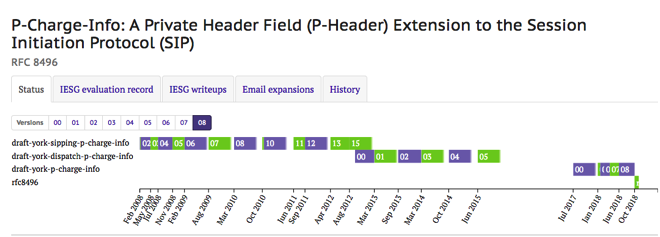
The Publishing of RFC 8496 Concludes the 10-year Saga of P-Charge-Info
Continue Reading: The Publishing of RFC 8496 Concludes the 10-year Saga of P-Charge-InfoOctober 31, 2018, was a special day for me. Not because it was Halloween, but because after 10 years a small little document I co-authored about the “P-Charge-Info” header for SIP-based Voice-over-IP (VoIP) was published as informational RFC 8496. You can see it at either:
Ultimately, all this document does is register the Session Initiation Protocol (SIP) Header Field of “P-Charge-Info” within the “SIP Parameters” registry maintained by IANA at:
But the story of getting that registration to happen is a long one!
In the beginning…
The short version is this. Back in around 2007 or so, I was working for Voxeo and we were using the “P-Charge-Info” header in our large SIP-based application server to pass along billing information. Essentially, when someone made a call on our system, we wanted to pass a billing identifier that was often different from the source phone number (i.e. “CallerID”). This quote from RFC 8496 was pretty much Voxeo’s use case:
As another example, a hosted telephony provider or hosted voice
application provider may have a large SIP network with customers
distributed over a very large geographic area using local market PSTN
numbers but… -
/
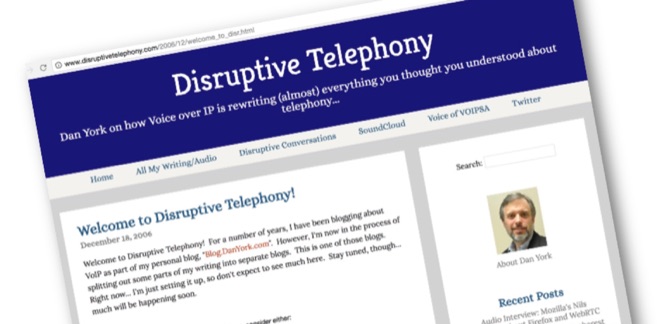
Celebrating 10 Years of Blogging at Disruptive Telephony
Continue Reading: Celebrating 10 Years of Blogging at Disruptive TelephonyTen years ago today, on December 18, 2006, I launched this blog with a very short 1-paragraph post:
Welcome to Disruptive Telephony! For a number of years, I have been blogging about VoIP as part of my personal blog, “Blog.DanYork.com”. However, I’m now in the process of splitting out some parts of my writing into separate blogs. This is one of those blogs. Right now… I’m just setting it up, so don’t expect to see much here. Stay tuned, though… much will be happening soon.
At the time, I was living in Burlington, Vermont, and working remotely for the Office of the CTO at Mitel Networks back up in Ottawa, Ontario (where we lived from 2000-2005). Dave Edwards, a friend from Ottawa, left the only comment on that post.
In 2006, the “VoIP blogging” world was quite small – and we all pretty much knew other. Om Malik was writing on his own site (it was yet to become GigaOm). Andy Abramson had VoIPWatch. Jeff Pulver was writing on his sites. Tom Keating at his “VoIP and Gadgets blog” on TMC. Martin Geddes had his “Telepocalypse” site. Alec Saunders had “Saunderslog”. And there were a few others…
… -
/
Facebook Messenger Launches Group Conference Calls (Audio-only)
Continue Reading: Facebook Messenger Launches Group Conference Calls (Audio-only)Continuing their efforts to be THE communication platform you use, the Messenger team at Facebook rolled out “group calling” this week within the Messenger app on iOS and Android. The new feature was announced by David Marcus, head of the FB Messenger team. Right now this is audio-only (i.e. not group video) and per media reports is limited to 50 participants.
I had to go to the AppStore and upgrade the Messenger app on my iPhone to the latest version, but once I did, I suddenly had a phone icon in the upper right corner of a group chat:
Tapping that phone icon brought me to a screen where I could choose which of the group members I wanted to bring into the group call:
After tapping “Call” in the lower right, Messenger launched the call and gave me feedback about who it was connecting, etc:
It then connected those who were available and four of us were in a group conference call:
As you can see in the screen captures, I had the standard buttons to mute my microphone and to activate the speakerphone.
AUDIO QUALITY – The audio quality was quite good. I couldn’t find any technical info…
-
/
Audio Recording: My SIPNOC 2014 Talk – “Is It Time For TLS For SIP?”
Continue Reading: Audio Recording: My SIPNOC 2014 Talk – “Is It Time For TLS For SIP?”Is it time to use Transport Layer Security (TLS… essentially what we used to call “SSL”) to add a layer of trust and security to Voice-over-IP (VoIP) that uses the Session Initiation Protocol (SIP)?Way back in June 2014, I gave a talk on this topic at the SIP Network Operators Conference (SIPNOC) in Herndon, Virginia. I recorded the audio of the session… but then lost track of the recording. I recently found it and, since much of it is (sadly) still relevant, I decided to release the recording as one of my The Dan York Report audio podcast episodes:
The slides that go with the presentation are available on SlideShare:
You’ll see in the slide deck that I also provide some tutorials around DANE and DNSSEC along the way.
Coincidentally, I learned on Facebook over the weekend that my friend Olle Johansson was speaking on this exact topic at the FOSDEM 2016 conference in Brussels this weekend. His slides about SIP & TLS are also available on SlideShare, and he has more recent information – and also the conclusion that we need to use “SIP Outbound” for any of this to work:
Olle’s last slide about what we need…
-
/
Talko’s Purchase By Microsoft Shows The Challenge Of The Directory Dilemma
Continue Reading: Talko’s Purchase By Microsoft Shows The Challenge Of The Directory DilemmaToday Microsoft announced that they acquired the technology of Talko, a communication app created by Ray Ozzie and launched back in September 2014. Fortune has an article on the acquistion, as do a good number of other media sites.After Talko first launched, I wrote about my initial experience – and the problem I had of Talko working through my home firewall. But I was intrigued by the possibilities laid out in a Medium article about how Talko could change communication and integrate voice, chat and messaging in interesting ways.
The reality, though, was that Talko was a classic case of suffering from the Directory Dilemma – as I said in that article:
People will only USE a communication application if the people they want to talk to are using the application.
And that was true for me… I tried out Talko, as I try out many apps. I used it for a while. And then… I stopped.
The people with whom I communicate were not regularly using Talko.
You can see the recognition of this dilemma in today’s front page of Talko’s web site:
However, as engaged as many of you have been, the reality is that the broad-based…
-
/
Video and Slides Now Available For My AstriCon 2015 Keynote: Open Source and The Global Disruption of Telecom
Continue Reading: Video and Slides Now Available For My AstriCon 2015 Keynote: Open Source and The Global Disruption of TelecomIf you’re interested in what I said last month at AstriCon 2015 in my keynote on “Open Source And The Global Disruption of Telecom: What Choices Will We Make?“, the video and slides are both available.As I wrote about previously, the context for this discussion was to talk about the changes that are happening all around us in terms of the ways in which we communicate. Here was the abstract:
There is a battle raging for the global future of telecommunications and the Internet. Taking place in networks, board rooms and legislatures, the battle will determine how we all communicate and what opportunities will exist. Will telecom support innovation? Will it be accessible to all? Will it give us the level of security and privacy we need to have the open, trusted Internet? Or will it be restricted and limited by corporate or government gatekeepers?
The rise of voice-over-IP has fundamentally disrupted the massive global telecommunications industry, infrastructure and policies. Open source software such as Asterisk has been a huge driver of that disruption and innovation.. but now what? What role do platforms such as Asterisk play in this space? And what can be their role in a telecom…
-
/
Keynote at AstriCon on Oct 14: Open Source And The Global Disruption Of Telecom – What Choices Will We Make?
Continue Reading: Keynote at AstriCon on Oct 14: Open Source And The Global Disruption Of Telecom – What Choices Will We Make?Two weeks from today I’ll be in Orlando giving the opening keynote address at AstriCon 2015. The abstract of the session is:
Open Source And The Global Disruption Of Telecom – What Choices Will We Make?
Wednesday, October 14th, 2015 – 9:00 am to 9:45 am – Pacifica Ballroom 7
There is a battle raging for the global future of telecommunications and the Internet. Taking place in networks, board rooms and legislatures, the battle will determine how we all communicate and what opportunities will exist. Will telecom support innovation? Will it be accessible to all? Will it give us the level of security and privacy we need to have the open, trusted Internet? Or will it be restricted and limited by corporate or government gatekeepers?
The rise of voice-over-IP has fundamentally disrupted the massive global telecommunications industry, infrastructure and policies. Open source software such as Asterisk has been a huge driver of that disruption and innovation.. but now what? What role do platforms such as Asterisk play in this space? And what can be their role in a telecom infrastructure that is now mobile, increasingly embedded (Internet of Things) and more and more using proprietary walled gardens of communication?
Join…
-
/
Firechat Enables Private Off-The-Internet (P2P) Messaging Using Mobile Phones
Continue Reading: Firechat Enables Private Off-The-Internet (P2P) Messaging Using Mobile PhonesThere was a fascinating article posted on Medium this week by the CTO of messaging app Firechat:
In the text he outlines how they do decentralized “off-the-grid” private messaging using an ad hoc mesh network established between users of the Firechat app. It sounds like the app instances join together into some kind of peer-to-peer (P2P) network and then do normal “store-and-forward” messaging.
Of note, the apps do NOT need an Internet connection, or even a cellular network connection – instead they can use the Bluetooth and WiFi radios in the mobile phones to create a private mesh network and connect to other users of the Firechat app.
Naturally, having spent some time exploring P2P networks back when I was playing around with P2P SIP and distributed hash tables (DHTs) and other technologies, I immediately jump into the techie questions:
- How are they routing messages from one user to another?
- How is the “directory” of users in P2P mesh maintained?
- What addresses are they using for the communication? Is this still happening over IP addresses? Or are they using some other kind of…
-
/
WebRTCHacks Publishes Analysis of Facebook and WhatsApp Usage of WebRTC
Continue Reading: WebRTCHacks Publishes Analysis of Facebook and WhatsApp Usage of WebRTCThe team over at webrtcH4cKS (aka “WebRTCHacks”) have been publishing some great articles about WebRTC for a while now, and I thought I’d point to two in particular worth a read. Philipp Hancke has started a series of posts examining how different VoIP services are using WebRTC and he’s started out exploring two of the biggest, Facebook and WhatsApp, in these posts:Those articles are summaries explaining the findings, with much-longer detailed reports also available for download:
Both of these walk through the packet captures and provide a narrative around what is being seen in the discovery process.
A common finding between both reports is that the services are not using the more secure mechanism of DTLS for key exchange to set up encrypted voice channels. Instead they are using the older SDES mechanism that has a number of challenges, but, as noted by the report, is typically faster in enabling a call setup.
All in all the reports make for interesting reading. It’s great to see both Facebook and WhatsApp using WebRTC and I think this will only…