
Category: IETF
-
/
Russ White On The Process Around Creating RFCs in the IETF
Continue Reading: Russ White On The Process Around Creating RFCs in the IETFHave you ever been curious about the process of creating a Request For Comments (RFC) document within the Internet Engineering Task Force (IETF)? These are the standards like, oh, “HTTP”, that power the Internet. Have you been interested in understanding how they work?
If so, someone I know, Russ White, recently completed a 7-part article series about the entire process over on the Packet Pushers Network site. Russ has nicely summarized the series on his site at:
https://rule11.tech/the-rfc-process/
He does a nice job providing an overview of the long process of starting with an idea, creating an “Internet draft”, working it through the IETF process, and then hopefully getting it published.
There are many more details, of course, but Russ lays out the high-level aspects and mentions some of the parts of the process which are harder to understand for someone new to the IETF.
If you are interested in the RFC process, I would encourage you to give Russ’ series of articles a read.
Using Markdown instead of XML
I do have one area of disagreement with Russ. He advocates for using XML for writing Internet drafts, whereas I used to write drafts in XML but have moved over…
-
/
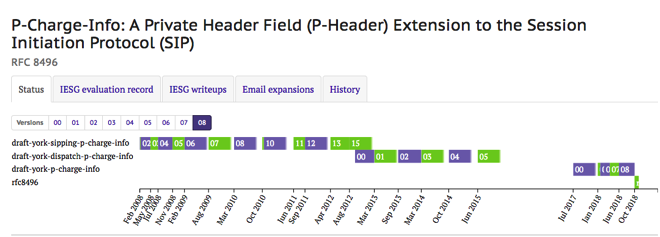
The Publishing of RFC 8496 Concludes the 10-year Saga of P-Charge-Info
Continue Reading: The Publishing of RFC 8496 Concludes the 10-year Saga of P-Charge-InfoOctober 31, 2018, was a special day for me. Not because it was Halloween, but because after 10 years a small little document I co-authored about the “P-Charge-Info” header for SIP-based Voice-over-IP (VoIP) was published as informational RFC 8496. You can see it at either:
Ultimately, all this document does is register the Session Initiation Protocol (SIP) Header Field of “P-Charge-Info” within the “SIP Parameters” registry maintained by IANA at:
But the story of getting that registration to happen is a long one!
In the beginning…
The short version is this. Back in around 2007 or so, I was working for Voxeo and we were using the “P-Charge-Info” header in our large SIP-based application server to pass along billing information. Essentially, when someone made a call on our system, we wanted to pass a billing identifier that was often different from the source phone number (i.e. “CallerID”). This quote from RFC 8496 was pretty much Voxeo’s use case:
As another example, a hosted telephony provider or hosted voice
application provider may have a large SIP network with customers
distributed over a very large geographic area using local market PSTN
numbers but… -
/
My First RFC – 7649 On “The Jabber Scribe Role at IETF Meetings”
Continue Reading: My First RFC – 7649 On “The Jabber Scribe Role at IETF Meetings”Last month the first Request For Comments (RFC) was published where I was one of the co-authors. Ironically, this RFC 7649 had nothing to do with SIP, VoIP, telecom, IPv6, DNSSEC, security… or any of the other open Internet standards I’ve been working on in recent years!
In fact, it’s not a “standard” at all but rather an “informational” document.
This document collects together a series of best practices for how someone can fill the role of the “jabber scribe” at IETF meetings, such as the IETF 94 meeting about to happen in Yokohama, Japan, starting this weekend. (Which I will not be attending due to scheduling challenges.) You can read RFC 7659 at:
As the abstract states:
During IETF meetings, individual volunteers often help sessions run more smoothly by relaying information back and forth between the physical meeting room and an associated textual chatroom. Such volunteers are commonly called “Jabber scribes”. This document summarizes experience with the Jabber scribe role and provides some suggestions for fulfilling the role at IETF meetings.
The document came about because over the years that I’ve been involved with the Internet Engineering Task Force (IETF) I’ve come to both value the critical role…
-
/
How Do We Define ‘SIP’ For Telecom In 2014?
Continue Reading: How Do We Define ‘SIP’ For Telecom In 2014?“What is a minimum set of specifications that a vendor must implement to be able to say that it is SIP-compliant?”A friend asked me that question and my response was:
It depends.
and even more unfortunately:
I don’t know.
It turns out to be a challenging question to answer… and it led me to ask:
- How do we define what “SIP” is for telecommunications in 2014?
- How do we help vendors move their products/services to be based on SIP?
- As we talk about “turning off the PSTN” and “moving all telecom to IP”, how can we make it easier for companies to switch to using SIP?
The reality is that being “SIP-compliant” does turn out to depend upon where in the larger SIP interconnection ecosystem the vendor is located.
Is the vendor:
- a SIP client, in terms of a “hard” phone, a softphone, or other application that is seeking to connect to a SIP server?
- a SIP server seeking to connect to a SIP “service provider” to have connectivity out to the PSTN and other SIP networks?
- a SIP service provider seeking to interconnect with other SIP service providers and to the PSTN?
- a middlebox such as a firewall…
-
/
Can We Create A “Secure Caller ID” For VoIP? (Join Tomorrow’s STIR BOF To Learn More)
Continue Reading: Can We Create A “Secure Caller ID” For VoIP? (Join Tomorrow’s STIR BOF To Learn More)Can we create a “secure Caller ID” for IP-based communications, a.k.a. voice-over-IP (VoIP)? And specifically for VoIP based on the Session Initiation Protocol (SIP)? Can we create a way to securely identify the origin of a call that can be used to combat robocalling, phishing and telephony denial-of-service (TDOS) attacks?
That is the challenge to be undertaken by the “Secure Telephone Identity Revisited (STIR)” group meeting tomorrow morning, July 30, 2013, at 9:00 am in Berlin, Germany, as part of the 87th meeting of the Internet Engineering Task Force (IETF). The meeting tomorrow is a “Birds Of a Feather (BOF)”, which in IETF language is a meeting to determine whether there is sufficient interest to create a formal “working group” to take on a new body of work within the IETF. The proposed “charter” for this new work begins:
Over the last decade, a growing set of problems have resulted from the lack of security mechanisms for attesting the origins of real-time communications. As with email, the claimed source identity of a SIP request is not verified, and this permits unauthorized use of source identities as part of deceptive and coercive activities, such as robocalling (bulk unsolicited commercial communications),…
-
/
Reminder – Opus Codec Presentation Streaming LIVE From IETF 87 in 2 Hours
Continue Reading: Reminder – Opus Codec Presentation Streaming LIVE From IETF 87 in 2 HoursWant to learn more about the Opus codec and why it is so important? As I mentioned at the end of my last post about why Opus matters, there will be a special presentation about Opus as part of the IETF 87 Technical Plenary happening in about 2 hours starting at around 17:45-18:00 in Berlin, Germany (Central European Summer Time, UTC+2, 6 hours off of US Eastern time).
There are three options for watching and participating live:
- using a WebRTC-capable browser (latest editions of Chrome and Firefox) and connecting to: http://www.meetecho.com/ietf87/tech_plenary
- listening to the audio stream at for either Potsdam 1 or Potsdam 3 (the plenary is in the combined room and I don’t know which stream will be used)
- watching a video live stream at: https://new.livestream.com/internetsociety/ietf87techplenary
The technical plenary begins at 17:40 but there are some other reports before the Opus section. The agenda can be found online and includes:
1. IAB Chair Report
2. IRTF Chair Report
3. RSE and RSOC Chair Report
4. Technical Topic: Opus Codec
a. Introduction
…
b. Overview of Opus
c. Testing
d. History of Opus in the IETF
e. Opus Deployment Panel
f. Future Work -
/
Why The Opus Codec Matters – Even If You Don’t Care About Audio
Continue Reading: Why The Opus Codec Matters – Even If You Don’t Care About AudioWhat makes the Opus codec so interesting? Why is there such a buzz about Opus right now? If you are not in telecom or doing anything with audio, why should you even remotely care about Opus?
In a word…
Innovation!
And because Opus has the potential to let us communicate with each other across the Internet with a richer and more natural sound. You will be able to hear people or music or presenters with much more clarity and more like you are right there with them.
Opus can help build a better user experience across the Internet.
You see, the reality is that today “real-time communication” using voice and video is increasingly being based on top of the Internet Protocol (IP), whether that communication is happening across the actual Internet or whether it is happening within private networks. If you’ve used Skype, Google+ Hangouts, any voice-over-IP (VoIP) softphones, any of the new WebRTC apps or any of the mobile smartphone apps that do voice or video, you’ve already been using IP-based real-time communication.
Dropping The Shackles Of The Legacy PSTN
Part of the beauty of the move to IP is that we no longer have to worry about the…
-
/
IETF Journal – WebRTC: Moving Real-Time Communication into the Web Browser
Continue Reading: IETF Journal – WebRTC: Moving Real-Time Communication into the Web BrowserSeeking to understand the basics of WebRTC and why there is so much interest in it? There is a new July 2013 issue of the IETF Journal out this week that includes an article I wrote titled “WebRTC: Moving Real-Time Communication into the Web Browser” that looks at WebRTC from a high-level user perspective.My aim with this IETF Journal article links was to summarize some of the links on my my WebRTC/RTCWEB page and is admittedly similar in style to my 2012 post, “How WebRTC Will Fundamentally Disrupt Telecom (And Change The Internet)“, although this newer article focuses on the work happening within the IETF and provides links to get more involved.
On that note, the RTCWEB working group within the IETF will be meeting next week in Berlin (twice, actually) and has an agenda for IETF87 focused primarily on security questions and looking at the “data channel” aspect of WebRTC/RTCWEB. It should, as always, be an interesting session to listen in to.
If you can’t get to Berlin, there are audio streams you can listen to remotely and a Jabber chat room where you can raise questions. Links to both can be found on the top…
-
/
Watch/Listen Live – FCC CTO Henning Schulzrinne on “The End of Plain Old Telephone System (POTS)” at 5:30pm EDT Tonight at IETF86
Continue Reading: Watch/Listen Live – FCC CTO Henning Schulzrinne on “The End of Plain Old Telephone System (POTS)” at 5:30pm EDT Tonight at IETF86In about 15 minutes, at 5:30pm US Eastern At around 6:00pm US EDT, Henning Schulzrinne, CTO of the US Federal Communications Commission (FCC) will be speaking on “The End of Plain Old Telephone System (POTS): Transitioning the PSTN to IP” at the technical plenary of the 86th IETF meeting happening this week in Orlando, Florida. You can listen or watch here:
- Audio stream – either Caribbean 3 or Caribbean 4
- Jabber chat: plenary@jabber.ietf.org
- Meetecho conferencing (webinar)
Henning’s slides are also available for download.
It should be quite an interesting session!
If you found this post interesting or useful, please consider either:
-
/
Sadly, The Big “C” Curtails My Participation Next Week At IETF 85
Continue Reading: Sadly, The Big “C” Curtails My Participation Next Week At IETF 85Sadly, the Big “C”, the current unwelcome guest in our family, has claimed another activity that I enjoy. Next week is the 85th meeting of the Internet Engineering Task Force (IETF). Some 1,200+ engineers will gather in Atlanta, Georgia, to discuss/debate/argue/evolve the open standards that make up the Internet. Things like TCP, HTTP, DNS, SIP, IPv6… all those protocols and their many, many offspring.For people who enjoy the process that creates these standards – and who enjoy the people that make up the IETF – these three-times-yearly face-to-face meetings are amazing places to be. One of the many aspects I enjoy of my work with the Internet Society is that I get to go to the IETF meetings and be part of all that is going on.
Unfortunately, I won’t be in Atlanta.
As I’ve mentioned in the past and written about publicly, my wife is in the second year of treatment for breast cancer. Every three weeks she goes in for an infusion of a drug called Herceptin, which is an antibody that goes after the HER2 protein. She has the treatment on a Monday and then is usually extremely fatigued for the next few days. Generally by…