Category: WebRTC
-
/
Audio Interview: Mozilla’s Nils Ohlmeier about Firefox and WebRTC
Continue Reading: Audio Interview: Mozilla’s Nils Ohlmeier about Firefox and WebRTCWant to learn the latest about WebRTC inside of Firefox? Nils Ohlmeier from Mozilla sat down for an interview at the IIT RTC Conference last week with Mark Fletcher of the Avaya Podcast Network. I found it quite a useful explanation of what Mozilla is doing with Firefox and how different aspects of WebRTC come into play in different parts of Firefox. Give it a listen…
-
/
Updated “Directory Dilemma” Article Now On CircleID…
Continue Reading: Updated “Directory Dilemma” Article Now On CircleID…Back in December, 2014, I published a post here called “The Directory Problem – The Challenge For Wire, Talko And Every Other “Skype-Killer” OTT App“. After receiving a good bit of feedback, I’ve now published a new version over on CircleID:The Directory Dilemma – Why Facebook, Google and Skype May Win the Mobile App War
I incorporated a good bit of the feedback I received and also brought in some newer numbers and statistics. Of note, I now have a section on WebRTC where I didn’t before. You’ll also notice a new emphasis in the title… I’m now talking about the potential winners versus the challengers. I also chose “Directory Dilemma” not only for the alliteration but also because the situation really isn’t as much a “problem” as it is an overall “dilemma”. It may or may not be a “problem”.
I’m not done yet.
I’m still seeking feedback. I intend to do yet another revision of this piece, but in doing so intend to:
- Change it from the informal tone at the beginning to more of a “paper” style;
- Include a bit more about potential solutions.
Comments and feedback are definitely welcome… either as comments here on…
-
/
WebRTCHacks Publishes Analysis of Facebook and WhatsApp Usage of WebRTC
Continue Reading: WebRTCHacks Publishes Analysis of Facebook and WhatsApp Usage of WebRTCThe team over at webrtcH4cKS (aka “WebRTCHacks”) have been publishing some great articles about WebRTC for a while now, and I thought I’d point to two in particular worth a read. Philipp Hancke has started a series of posts examining how different VoIP services are using WebRTC and he’s started out exploring two of the biggest, Facebook and WhatsApp, in these posts:Those articles are summaries explaining the findings, with much-longer detailed reports also available for download:
Both of these walk through the packet captures and provide a narrative around what is being seen in the discovery process.
A common finding between both reports is that the services are not using the more secure mechanism of DTLS for key exchange to set up encrypted voice channels. Instead they are using the older SDES mechanism that has a number of challenges, but, as noted by the report, is typically faster in enabling a call setup.
All in all the reports make for interesting reading. It’s great to see both Facebook and WhatsApp using WebRTC and I think this will only…
-
/
Wow! Cisco To Acquire Tropo’s Communications Application Platform
Continue Reading: Wow! Cisco To Acquire Tropo’s Communications Application PlatformWOW! In companion blog posts today Cisco and Tropo announced Cisco’s intent to acquire the Tropo team and platform:- Cisco blog: Cisco Announces Intent to Acquire Tropo
- Tropo blog: Tropo joins Cisco to Power next-gen collaboration APIs
As someone who was at Voxeo in 2009 and helped launch Tropo (and wrote many of the early blog posts about it[1], as well as some of the python samples), I’m thrilled for the team there now that this is happening.[2]
Congratulations to all involved!
Over the years since leaving Voxeo, I’ve written about Tropo from time to time and continued to watch its progress. I’ve continued to be very impressed by what they’ve done over the years. They’ve truly made it easy for people to create powerful applications using simple programming languages.
It looks like the Tropo website is struggling right now so here is a snippet of their announcement post:
Six years ago we launched Tropo with the idea to make it easy to power phone calls through a simple API. Since then, we’ve empowered thousands of developers to add voice and messaging to their applications.
From our very first sign-up in 2009, to powering thousands of mobile and…
-
/
Wire Launches WebRTC Voice/Chat Web App For Windows, Linux, more – Includes High TLS Security
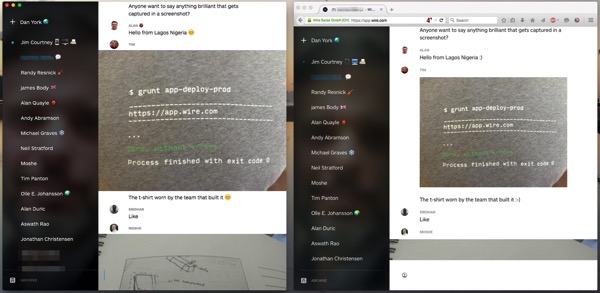
Continue Reading: Wire Launches WebRTC Voice/Chat Web App For Windows, Linux, more – Includes High TLS SecurityYesterday the team over at Wire launched a new WebRTC-based “Wire for Web” app that lets people on Windows, Linux or any other platform now communicate with people using Wire on iOS, Android or OS X. You can get to it simply at:https://app.wire.com/
If you already have an account you simply sign in with your credentials. If you don’t have an account you can easily create one.I’ve been running both the native Mac OS X client and the web client for a bit now (I was part of web beta program for Wire) and it is truly amazing how well the team has made the web experience to be seamless between the web and native client. Here’s a screenshot showing both side by side (click/tap for a larger image):
In the web view on the right you have the browser bars at the top and one of the images did not go the full width of the column, but otherwise the experience and visual display has been essentially identical between the two platforms. The synchronization between the two is nearly instantaneous and all the features work really, really well.
Notifications in the web browser (if you allow…
-
/
Congrats to the Jitsi Team On Their Acquistion By Atlassian
Continue Reading: Congrats to the Jitsi Team On Their Acquistion By AtlassianCongratulations to Emil Ivov and the whole team behind Jitsi for their acquisition by Atlassian! As they say on the Jitsi news page:
The Jitsi Community just got a lot stronger! BlueJimp, founder of Jitsi, is now part of Atlasssian! The plan is to keep Jitsi at the cutting edge of innovation by keeping it open and in the hands of those who created it in the first place: the open source community.
The news is outlined in an article on TechCrunch and explained in more detail in a HipChat blog post.
To be clear, Atlassian is acquiring the company BlueJimp that employed the founders of Jitsi, but in the process they are also effectively getting the open source Jitsi project. It’s great to read in their blog post, though, that they intend to continue to support and invest in the project.
I’ve been a big fan of Jitsi for quite some time as it was one of the earliest VoIP clients to support both IPv6 and DNSSEC. I wrote about this support both here and also over on the Deploy360 blog and recorded this video interview with Emil Ivov:
Previously I’d also written about Jitsi’s support for DNSSEC as…
-
/
The Directory Problem – The Challenge For Wire, Talko And Every Other “Skype-Killer” OTT App
Continue Reading: The Directory Problem – The Challenge For Wire, Talko And Every Other “Skype-Killer” OTT AppAs much as I am enjoying the new Wire app, there is a fundamental problem that Wire faces… as well as Talko, Firefox Hello and every other Over-The-Top (OTT) or WebRTC application that is seeking to become THE way that we communicate via voice, chat and/or video from our mobile phones and desktops. That is:How do they gather the “directory” of people that others want to talk to?
The fundamental challenge all of these applications face is this:
People will only USE a communication application if the people they want to talk to are using the application.
And where I say “talk” it could also be “chat” or “message” or… pick your communication verb.
It’s all about the “directory” of users.
There’s a war out there right now… and it’s a war for the future of our communications between each other. It’s a war for messaging… and it’s also a war for voice and video.
And it all comes back to… which communications application or service can provide the most comprehensive directory of users?
Which communications tool will be the one that people use the most? Will any of them replace the default communications of the mobile phone? NOTE:…
-
/
More Observations About The “Wire” App
Continue Reading: More Observations About The “Wire” AppAfter yesterday’s launch of Wire, I continued to use it a bit today and am writing these notes, mostly for my own memory.Group Chats ARE Persistent
In my post yesterday I said that it seemed like Wire group chats were “persistent” (something I’d previously written about with regard to Skype). Today I can confirm that they ARE persistent. When I fired up the Wire app this morning I received all the messages that had been posted into the group chat overnight while I’d been offline.
Further, when I went to add someone to the group chat, I received this message:
The Wire team also deserves credit for how smoothly they make the scrolling back through the chat history. Works very well!
No IPv6… yet
Friends tested Wire in an IPv6-only network and confirmed that it unfortunately does not yet work. In reaching out to someone at Wire the word was that they are definitely investigating this to see what can be done. The issue is that the Wire app connects to Amazon EC2 servers – so it’s really an issue of Amazon’s capabilities.
I will say again that Wire at the very least deserves credit for coming out with…
-
/
Initial Thoughts On “Wire”, The New Communication App From Ex-Skypers
Continue Reading: Initial Thoughts On “Wire”, The New Communication App From Ex-SkypersAnother remarkable day in Internet communications! Today brought the launch of “Wire“, a “modern communications network” that runs on iOS, Android, Mac OS X and soon in WebRTC-equipped web browsers.My first thought was naturally – do we really need YET-another-OTT-communication app?
After all, my iPhone is littered with the dead carcasses of so many other apps that have launched trying to be THE communication platform we all want to use. (And indeed I’ve written about many of them here on this site.)
But what makes Wire different for me from so many other similar apps that have launched (and faded) is really the PEOPLE involved. The news announcement mentions, of course, Skype co-founder Janus Friis as one of the big names behind Wire. Jonathan Christensen is also the co-founder and CEO of Wire. The news post says this:
The company’s team comprises former product and technology leaders from Apple, Skype, Nokia, and Microsoft. Christensen held leadership roles at Microsoft and Skype, and was co-founder and CEO at Camino Networks. Along with Christensen, founders include Alan Duric, Wire’s CTO, a co-founder of Telio (Oslo exchange TELIO) and co-founder of Camino (acquired by eBay/Skype); and Priidu Zilmer, Wire’s head…
-
/
How To Test Firefox Hello, Mozilla’s New WebRTC Video Call Service
Continue Reading: How To Test Firefox Hello, Mozilla’s New WebRTC Video Call ServiceWow! Mozilla’s new Firefox 34 includes a great new WebRTC-based feature called “Firefox Hello” that lets you call people without requiring them to have an account with Firefox. You simply send them a URL via email, chat or some other method – and they can start calling you from within Firefox.Here’s all you need to do to try it yourself. First, you need Firefox 34, of course. Once you have upgraded or installed the software, you should see a “Hello” button over on the far right side of the browser’s top bar:
If you don’t see this button, as I didn’t, you may have to perform the following steps, as documented in a Firefox help page:
1. Open the “Customize” section of the browser to add the “Hello” button to your menu bar:
2. Drag the “Hello” button to the browser bar or to the drop-down menu.
Now, in my case, that still didn’t work and I had to use the additional trick mentioned in the help article of going to http://about:config and changing “loop.throttled” to “false” (simply by clicking on that setting). After restarting Firefox I was then able to go into the Customize window and add…