Category: VoIP
-
/
Rich Tehrani on DiamondWare, "3-D audio conferencing" and how the sound of telephony is changing
Continue Reading: Rich Tehrani on DiamondWare, "3-D audio conferencing" and how the sound of telephony is changingThose who know me well are aware that one of my hot buttons is my belief that one of the greatest disruptive potentials of VoIP is to fundamentally change the sound of telephony. With VoIP, we are no longer constrained to the 3.5kHz frequency range of the PSTN… I’ll save my wideband rant for another day, but tonight I’ll just point you over to Rich Tehrani’s post “DiamondWare in HD“, which talks about the power of DiamondWare‘s “3-D” stereo technology. As Rich describes in his blog entry:
Once on the call I was able to easily position the three callers all around me. One could be directly ahead of me and one on either side. The computer can automatically position participants as well if you so choose.
When everyone was in place, Keith had one coworker start counting from 1 and another reciting the alphabet from letter “A.” While these two participants spoke, Keith proceeded to speak with me and the strangest thing happened. I could focus on anyone I wanted and was able to absorb what all three participants were uttering.
It was an amazing experience and the sound quality was beyond compare. I could hear everything in…
-
/
Mitel connects directly to Microsoft Exchange Server 2007 via SIP
Continue Reading: Mitel connects directly to Microsoft Exchange Server 2007 via SIPIn my incredibly long queue of things I’ve wanted to write about for the past few weeks, one item was the Mitel news release about making a direct SIP connection to Microsoft Exchange Server 2007 Unified Messaging. The cool part is that you can just use our basic 3300 ICP communications platform (or IP-PBX, or whatever you want to call it) and connect it directly into a Microsoft Exchange Server to use the Exchange Server for a unified inbox (email, voicemail, fax, etc.). No other boxes or gateways necessary. Just a nice, standard SIP trunk. As a long-time proponent of open standards and general “standards geek”, it really can’t get much better. It’s great to see.
Technorati tags: mitel, microsoft, exchange, voip -
/
MAKE: Turning an antique phone into a USB headset (and therefore Skype phone)
Continue Reading: MAKE: Turning an antique phone into a USB headset (and therefore Skype phone)Through a link from Phil Wolff, I learned that Bruce Stewart has posted at the Emerging Telephony blog about someone turning an antique phone into a Skype phone (which actually points to a post on the MAKE Blog). Okay, so as best I can tell, it’s really a glorified USB headset, but I admit that the geek side of me finds it rather a fun idea. Bruce links to a page on the Instructables site that has more pictures and instructions.
(I’d note that while the articles say that it is an “antique Skype phone”, it really looks to me like it’s a USB headset, so it could really work with any VoIP program.)
Fun stuff…
Technorati tags: skype, etel, make, voip -
/
Attaining BLISS… (at least in the world of SIP)… a.k.a. why can’t we all just get along?
Continue Reading: Attaining BLISS… (at least in the world of SIP)… a.k.a. why can’t we all just get along?So you’d like your SIP phones to all work together, eh? And you’d like your SIP phone from Vendor A to work with the SIP phone of Vendor B and yet give you the business functionality that you used to have in the PBX from Vendor C?
Good luck.
Yes, they will (or should!) all work together for basic call functions, but if you want to do more than just the very basics, you rapidly wind up in the realm of incompatible SIP implementations. Different vendors support different RFCs… or interpret RFCs differently. It’s a challenge to go beyond basic functionality.
Enter “BLISS“, one of the latest working groups coming out of the IETF. It stands for “Basic Level of Interoperability for SIP Services” and, as noted in its charter, the intent is to define a basic set of functionality (“minimum interoperability requirements”) to allow SIP endpoints to interoperate on 4 specific telephony services:
- Bridged/Shared Line Appearance (BLA/SLA)
- Call Park/Pickup
- Do Not Disturb (DND)
- Call Completion to Busy Signal/Call Completion on No Reply
More details are on the charter page. These are just the initial four issues chosen to be addressed and Internet-Draft documents are already circulating on…
-
/
So who will be first vendor to implement VoIP over RFC4824?
Continue Reading: So who will be first vendor to implement VoIP over RFC4824?So with the release yesterday of RFC4824, The Transmission of IP Datagrams over the Semaphore Flag Signaling System (SFSS), one has to wonder… which of the vendors will be the first to attempt to implement VoIP transmission in this medium? I think it would make for a rather slower conversation, but it would certainly be intriguing. Hmmm… I wonder which would be faster – this method? Or the avian method defined in RFC2549. Probably this one, methinks.
Oh, you have to love a standards body with a sense of humor…
Technorati tags: ietf, rfc4824, semaphore, voip -
/
Hmmm… VoIP News’ "Hacking PBX: 20 Tips" is really "15 Tips and 5 Advertisements"
Continue Reading: Hmmm… VoIP News’ "Hacking PBX: 20 Tips" is really "15 Tips and 5 Advertisements"First, let me state that I like the VoIP News website. They’ve been producing a lot of great articles that we pretty regularly talk about over on Blue Box. Their “50 Most Influential People in VoIP” was a great catalog of the people really moving VOIP forward. Heck, one of their writers even interviewed me and I was quite pleased with the resulting article (something that definitely is not always true).
However, I was rather annoyed to read their “Hacking PBX: 20 Tips and Tricks to Optimize your Business Phone System” article that came out yesterday. Not because of the content, which was (mostly) actually quite good, but more because the title didn’t at all line up with the reality. Here’s the reality:
It’s not 20 tips and tricks… it’s 15 tips/tricks and 5 advertisements.
Which is too bad, really. I was really enjoying reading down through the article because these are all good things to have as part of a PBX system (and pretty much all are available through solutions from my employer, Mitel, although we haven’t integrated GPS as mentioned in #9 :-). Everything was cool and useful up through #15…
… and then suddenly with #16…
-
/
SkypePrime – for a 30% cut to Skype, you can charge people to call you and offer fee-based services to the Skype community… (and will it all turn into porn calls?)
Continue Reading: SkypePrime – for a 30% cut to Skype, you can charge people to call you and offer fee-based services to the Skype community… (and will it all turn into porn calls?)UPDATE: Phil Wolff over at Skype Journal has had some great detailed coverage of Skype Prime over at Skype Journal.
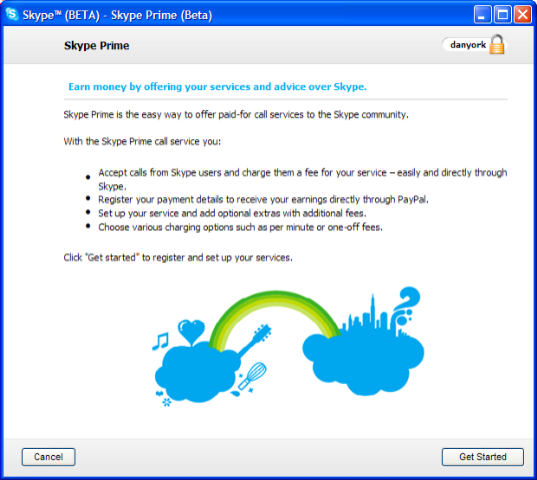
News out of Skype today is that a new 3.1 beta includes a new service called SkypePrime, where you can charge someone to call you for either a one-time fee or a per-minute fee. It also marks the beginning of the frequently-discussed integration of Skype and PayPal, because the payments go into your PayPal account. However, the payment is deducted from the payer’s SkypeCredit (so you are paying in SkypeCredit and the receiver is getting it in PayPal). Here’s the relevant part of the blog entry:
When you call someone who is a Skype Prime call provider, and you both have the new version of Skype, the provider can initiate what we call a “payment request”. That is, all calls start as free, but you can then switch to the paid calling, charging either by the minute or a one-off fixed fee. The call then proceeds as a paid Skype Prime call and your Skype Credit is deducted by the appropriate amount that then goes to the receiver’s account. The provider does not get the call fees directly as Skype…
-
/
Alec Saunders has videos and summary of ETel "LaunchPad" presentations (new VoIP startups)
Continue Reading: Alec Saunders has videos and summary of ETel "LaunchPad" presentations (new VoIP startups)Two of the cool “events” at the Emerging Telephony conference last week were the “Mashup Contest” and the “LaunchPad” (sponsored by GigaOm). In both cases new companies or developers were able to show off their products. I was going to write up my thoughts and summary, but it turns out that Alec Saunders posted about all the companies and included video of their presentations. Definitely worth a look to see what companies are doing around emerging telephony apps and services. Thanks to Alec for recording them all.
Technorati tags: voip, etel2007, etel, oreilly