Author: Dan York
-
/
New Facebook voice app: VoxCall lets you do free calls between SIP phones/numbers
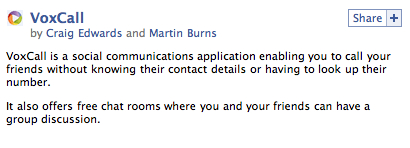
Continue Reading: New Facebook voice app: VoxCall lets you do free calls between SIP phones/numbersBy way of my Facebook NewsFeed this morning, I learned that several friends had installed a new Facebook app called “VoxCall” (must be logged into the walled garden of Facebook to see the link). A quick Technorati search brought me to Alex Saunders’ blog post on the subject which clued me in to the fact that this was from the folks at Voxalot, some of whom I’d met down at Fall VON in Boston.
[Side Rant: This also shows the inherent weakness and stupidity of Facebook’s current implementation of “groups”. The Voxalot folks had posted info about this app in both the news and wall of their Facebook group, but of course I would never see it unless I just randomly happened to go there. Had they sent a message to all group users, I would have seen it in my Facebook Inbox, but it would be nice if instead Facebook had some way to notify you that you had new info in the groups to which you subscribe.]
The VoxCall app is basically a “click-to-call” app that makes use of Facebook’s directory. You simply click on the name of someone else who has the app installed…
-
/
I’ll be out in Vancouver Dec 2-7 for the 70th meeting of the IETF.
Continue Reading: I’ll be out in Vancouver Dec 2-7 for the 70th meeting of the IETF.Just confirmed travel plans today – I will be heading out to the 70th meeting of the Internet Engineering Task Force (IETF) in Vancouver, British Columbia, Canada, from December 2-7. If any readers will be out there (either for the IETF or in Vancouver in general), please do drop a note and let me know. This will be my first meeting in my new role with Voxeo and I’m very much looking forward to renewing old acquaintances and also getting more directly involved with the work of the IETF.
-
/
Verizon brings in 40 Gbps IP circuits… OC-768, anyone?
Continue Reading: Verizon brings in 40 Gbps IP circuits… OC-768, anyone?Having been online now since the early 1980s and having watched/used the ever-increasing amounts of bandwidth we have available, it still made me pause to read that Verizon Business has launched 40Gbps connections on its backbone using Juniper Networks routers.
40 Gbps?
Pretty mind-blowing, considering where we have come from. I’ll spare you all the tugging on my beard (that is now gray in spots) and reminiscing about how we all had to connect at 110 baud using acoustic couplers… I will say that back in the late 1990’s when I wrote the Networking Essentials Exam Guide, I did cover the OC-n naming convention for connections, but I don’t think we would ever have imagined that some day there would be “OC-768”. Pretty cool!
Not that we as consumers will necessarily see that bandwidth anytime soon… but it is nice to know it is there in the backbone. (Also interesting that they note that the growth of their VoIP offerings is one of the reasons for being interested in this backbone.)
-
/
Did you know RFC 4733 had replaced/obsoleted RFC 2833 for DTMF signaling in SIP?
Continue Reading: Did you know RFC 4733 had replaced/obsoleted RFC 2833 for DTMF signaling in SIP?Did you know that RFC 4733 replaced/obsoleted RFC 2833? I just learned this myself through a SIP Forum mailing list exchange the other day. For those not aware, RFC 2833 and now 4733 define methods of carrying DTMF signals (and other similar signaling) in RTP streams separate from the main audio component of the RTP stream. A typical example of use might be where you were using a highly-compressed audio codec for audio between two SIP endpoints where the high degree of compression might make it challenging for the DTMF tones to be correctly interpreted on the receiving end. Using “RFC 2833 compliant” signaling, the sending SIP endpoint would send those DTMF tones as separate packets within the RTP stream.
My key takeaway from learning about RFC 4733 is that we should really be talking about “RFC 4733 compliant” signaling… but given that the industry is really only now starting to really talk about “RFC 2822 compliant” signaling, I’m not sure I expect to see that happening anytime soon.
Anyway, here’s the abstract from RFC 4733 – you can naturally read the rest of the document to understand more:
This memo describes how to carry dual-tone multifrequency (DTMF) signalling, other…
-
/
Want to see the people I work with? – Voxeo’s office and people… as seen via Flickr
Continue Reading: Want to see the people I work with? – Voxeo’s office and people… as seen via Flickr
IMG_0112.JPG
Originally uploaded by voxeophoto As most of you know by now I’m now employed by Voxeo and the folks down in the Orlando office recently started using some camera’s to upload pictures to company Flickr stream. We did this largely because we’re hiring (more job openings to be posted soon) and we want potential candidates to see what a fun place it is to work… but it will also factor into some of the other blogging and other work we’ll be doing.Anyway, you can check it out. No photos of me there, yet, since I wasn’t around when the camera’s were being passed around. (I’ll upload a picture of me to the site, though, soon.)
-
/
Jeff Pulver on the status of VoIP-related legislation in the USA…
Continue Reading: Jeff Pulver on the status of VoIP-related legislation in the USA…I haven’t written much here about the state of VoIP-related regulations in the USA, but Jeff Pulver just did yesterday on his blog with his post, “VoIP in America: The State of VoIP“. I would encourage you to give it a read, even if you don’t live in the USA. It’s great that we all are building useful technologies… but we also need to make sure that government regulations do allow us to use those technologies.
Technorati Tags: politics, regulation, voip
-
/
A simple answer to why I’ve done more videoconferencing in the past 3 weeks than I have in the past 3 *years*…
Continue Reading: A simple answer to why I’ve done more videoconferencing in the past 3 weeks than I have in the past 3 *years*…In the past three weeks I have done more videoconferencing than I have in the past three years…including my year or so as the product manager for Mitel’s video collaboration products.
Why?
There’s a simple answer, really. And it speaks to the heart of why I think it has taken so long for videoconferencing to take off… I mean, we’ve have been talking about videophones for what? 40 years or so?
The answer is… duh!… I have a camera always available!
It is always there, sitting at the top of my MacBook Pro screen, just waiting to be used. Whenever I am in a Skype call, or using Sightspeed or iChat… or any other communication program that supports video… moving into video is as simple as pressing a button in the GUI and… ta da… we’re in a video conversation.
Contrast that to the situation a few years back where moving into video involved making sure your camera was connected first. In fact, some of the various programs required a restart after you connected a camera, which meant that you couldn’t just escalate into video while you were in the midst of a call. Back when I was…
-
/
It’s about the platform – Google finally answers the “Gphone” speculation… with an Android!
Continue Reading: It’s about the platform – Google finally answers the “Gphone” speculation… with an Android!“It’s about an open platform, stupid!” While I didn’t include Google when I first wrote my post about how voice is really all about application platforms, I did note in the comments that I had intended to do so… and today’s announcement really shows that they should be in anyone’s list of telephony application platforms. As announced on the Google blog with “Where’s my Gphone?“, Google today announced the Open Handset Alliance and the associated set of forthcoming software called Android. The front page of the Open Handset Alliance provides a rather compelling (to me) statement:
What would it take to build a better mobile phone?
A commitment to openness, a shared vision for the future, and concrete plans to make the vision a reality.
Welcome to the Open Handset Alliance™, a group of more than 30 technology and mobile companies who have come together to accelerate innovation in mobile and offer consumers a richer, less expensive, and better mobile experience. Together we have developed Android™, the first complete, open, and free mobile platform.
We are committed to commercially deploy handsets and services using the Android Platform in the second half of 2008. An early… -
/
VON – Innovator’s Forum “Unconference” agenda posted
Continue Reading: VON – Innovator’s Forum “Unconference” agenda postedHere at VON in the “Innovator’s Forum”, we’ve now bashed out a schedule for the “unconference” portion of today’s schedule. For those interested, it is posted on the VONCamp page and is:
- Social Networking Conversation 1:30 PM – 1:55 PM
- Residential VoIP – Can it be Sold as a Product? Dennis Peng, Ooma and Jon Arnold, J Arnold & Associates (M) 1:55 PM – 2:20 PM
- The Ruby Way / Watch a mashup in real time 2:20 PM – 2:45 PM
Should be fun…
Technorati Tags: conferences, fallvon, voip, von