
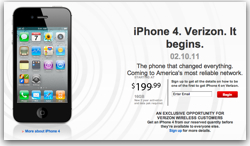
 Once upon a time, I firmly believed that the day the iPhone launched on Verizon would be the day you could pretty much count AT&T out. I expected that would be a huge migration of users… and it would be the end…
Usually those thoughts came on days when I was having serious issues with AT&T’s network and could only wish for the end of the AT&T monopoly to come… I live in southwestern New Hampshire and AT&T’s network is merely “okay” in Keene, NH, and gets pretty abysmal – and nonexistent – when you travel not too far out of town. Driving the hour-plus over to the Manchester airport there are 2 or 3 pockets where I literally have no coverage for a few minutes with my iPhone 4 on AT&T’s network.
Meanwhile, of course, Verizon has rock solid coverage throughout our area.
Unless you have been hiding in a cave, you know that today is the day Verizon announced the iPhone, with the actual phone being available on February 11th. There are a zillion news articles in every imaginable media out… the ginormous media feeding frenzy is something to behold. A huge amount of publicity for Apple… for a phone… and for one that has been out for a while.
The Mass Exodus
But I no longer expect the mass exodus from AT&T.
Largely because, as Mashable noted (as did others), AT&T has already protected itself by setting up huge Early Termination Fees. There is also the cost of buying a new iPhone as you need a CDMA phone vs a GSM phone (and then the issue of selling your old AT&T one).
I see a couple of other issues, too, that may impact only “power users”, but still are issues that may prevent switching:
- Multi-tasking – My understanding is that with CDMA you cannot use your data connection while you are on a phone call. To me this is a fairly big issue. When someone actually calls me on my iPhone 4, it’s often because they want some piece of information right then. Very typically I will be on the phone with them and will pull up a web browser or email to retrieve the information they may need (if I’m not near my computer). I can do this on a GSM iPhone 4 on AT&T. I apparently can’t on Verizon’s network.
- International travel – While the vast majority of US customers probably will not be doing too much travel outside the US, some of us will… and Verizon’s CDMA limits you to “40 countries”, which, if you look at the list of countries is basically Canada, Mexico, China, India, Israel, a host of Caribbean/Pacific island nations, a few South American countries and a few other random nations. I’m not planning to travel to Yemen any time soon, but odds are that I will be going to Europe, where my Verizon iPhone 4 is useless. (And Verizon’s only overall solution is to use a device that does both CDMA and GSM.)
- Will the network hold up? While Verizon may tout its network as the “most reliable”, I think many of us will be curious to see how well Verizon’s network stands up under the onslaught of the data-intensive usage of the iPhone. Maybe it truly will work well… maybe it, too, will fail.
There is also the “speed” issue, which is causing some to say they will stick with AT&T, although in my personal case it doesn’t matter what the speed is if you have no coverage!
For all these reasons, I don’t expect to see a mass exodus from AT&T…
yet!
I do, though, expect that many new iPhone 4 customers will opt for Verizon over AT&T. Last year we got an iPhone for my wife, and had Verizon been an option we certainly would have gone that route for her, primarily for the coverage in our area.
I also expect that many renewing AT&T customers may consider the switch. Particularly in a year or so when the “iPhone 5” or whatever comes next is launched. At that point the cost to “upgrade” to the new iPhone X on the Verizon network may not be that big of a deal.
Meanwhile, I expect that many of us on AT&T’s network will avoid paying the ETF fees and just suck it up and deal with our lock-in.
Why Google May Be The Biggest Loser
I think, though, that Google may be the biggest loser out of the news today. While AT&T had its monopoly on the iPhone, Verizon was the largest North American champion of the Android mobile operating system. Its “droid” commercials were ubiquitous on TV and other media, and its print ads were visible all over the place.
While I’m sure that Verizon will continue to market all of its various Android devices, the fact is that it now has the “must have” consumer device… the iPhone… and they have less incentive to push the Android devices.
Sure, the counterpoint is that AT&T now may market more of the Android devices to deal with loss of iPhone customers to Verizon. And maybe they will… and maybe that will make up for what Verizon would have promoted.
There is a part of me that would like that to be the case… I’d very much like to have a mobile ecosystem of devices with solid competition that encourages innovation and ensures we don’t have a monopoly.
But it’s also the iPhone… and as an iPhone user for several years now I will say that the complete user experience is incredibly seductive… more so than the Android devices I’ve had the chance to play with.
We’ll have to see… the next year or so will be both an incredibly interesting and also turbulent time in this mobile space.
Will You Switch?
What do you think? If you are an AT&T iPhone user, will you switch? Now? or at renewal? If you are a Verizon Android user, are you tempted by the iPhone? Where do you see all this going?
If you found this post interesting or useful, please consider either:
4 responses to “Why Verizon’s iPhone 4 is Worse for Google Than For AT&T”
If this was a CDMA+GSM phone (what Verizon calls a “world phone), I would have switched.
The inability to do voice+data at the same time means WebEx’s screen sharing and it’s “who is talking” feautures won’t work, as those are of course delivered over a data channel. Note that AT&T’s EDGE has exactly the same limitation. The original iPhone was EDGE only.
No. I will not be switching. As big as the news about the Verizon iPhone is, I think I will stick with my Android phone on Tmobile. It does voice and data at the same time, with 4G speeds, sports a front facing camera, and wireless tethering, and works internationally, with unlimited data, at a rate lower than any Verizon or ATT plan.
But thanks for asking.
Dave M
No, sir. I have no desire to own an iPhone. On either of those carriers. Like Mr Michels I find that T-Mobile is my carrier of choice. They are, in effect, the least evil of the CellCos. (“most customer friendly” if you would rather) Being the least evil makes them a good match for Google’s Android OS. I’ve been enjoying the G2 with HSPA+ and tethering for zero added cost. I like the real keyboard more than the front facing camera…for now.
My understanding is that with CDMA you cannot use your data connection while you are on a phone call. To me this is a fairly big issue.
It’s the DO in EV-DO – Evolution-Data Only. There was also, back in the 1x standardisation process, EV-DV (Evolution-Data and Voice) but that never got deployed. In UMTS, there are separate CS and PS domains for circuit switched and packet switched services, in parallel as far as the RNC. In LTE, essentially, there’s a single radio interface and it’s (currently) implementation dependent whether you do SIP VoIP or SIGTRAN circuits-over-packets or circuit switched fallback for the voice service.
I’m a surprised they bothered to do a CDMA2000 iPhone this late in the day. Verizon is rolling out LTE – supposedly the Alcatel deployment teams are going pretty fast – and presumably wanting to replace CDMA2k with it. And so is everyone else, eventually. The standards wars are over. I can’t imagine why you’d want an iPhone but with crippled roaming but then that’s me being European.
The simplest explanation I can see would be that the radio stack in these iPhones is one of Qualcomm’s new switch-hitters and they’ll push out a firmware update to activate LTE support when the LTE network is ready for them.